"When they have spread this darkness abroad and torn religion out of
men's hearts, these accursed philosophers proceed to destroy the bonds
of union among men, both those which unite them to their rulers, and
those which urge them to their duty. They keep proclaiming that man is
born free and subject to no one, that society accordingly is a crowd of
foolish men who stupidly yield to priests who deceive them and to kings
who oppress them, so that the harmony of priest and ruler is only a
monstrous conspiracy against the innate liberty of man.
Everyone must understand that such ravings and others like them,
concealed in many deceitful disguises, cause greater ruin to public calm
the longer their impious originators are unrestrained. They cause a
serious loss of souls redeemed by Christ’s blood wherever their teaching
spreads, like a cancer, it forces its way into public academies, into
the houses of the great, into the palaces of kings, and even enters the
sanctuary, shocking as it is to say so."
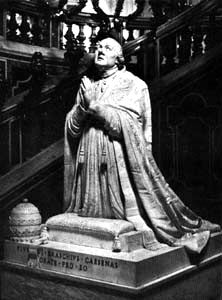
-Pope Pius VI, “Inscrutabile” (On The Problems Of The Pontificate)
Showing posts with label conviction. Show all posts
Jul 11, 2013
Jul 3, 2013
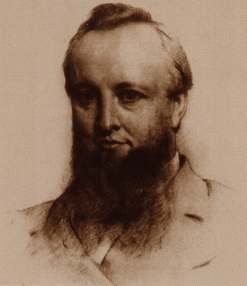
Lord Acton on Liberty
“Civil and religious liberty are so commonly associated in people’s
mouths, and are so rare in fact, that their definition is evidently as
little understood as the principle of their connection. The point at
which they unite, the common root from which they derive their
sustenance, is the right of self-government. The modern theory, which
has swept away every authority except that of the State, and has made
the sovereign power irresistible by multiplying those who share it, is
the enemy of that common freedom in which religious freedom is included.
It condemns, as a State within the State, every inner group and
community, class or corporation, administering its own affairs; and, by
proclaiming the abolition of privileges, it emancipates the subjects of
every such authority in order to transfer them exclusively to its own.
It recognises liberty only in the individual, because it is only in the
individual that liberty can be separated from authority, and the right
of conditional obedience deprived of the security of a limited command.
Under its sway, therefore, every man may profess his own religion more
or less freely; but his religion is not free to administer its own laws.
In other words, religious profession is free, but Church government is
controlled. And where ecclesiastical authority is restricted,
religious liberty is virtually denied.”
May 29, 2013
Lactantius on the Free Will of Religious Association
"Oh
with what an honorable inclination the wretched men go astray! For they
are aware that there is nothing among men more excellent than religion,
and that this ought to be defended with the whole of our power; but as
they are deceived in the matter of religion itself, so also are they in
the manner of its defense. For religion is to be defended, not by
putting to death, but by dying; not by cruelty, but by patient
endurance; not by guilt, but by good faith. … For if you wish to defend
religion by bloodshed, and by tortures, and by guilt, it will no longer
be defended, but will be polluted and profaned. For nothing is so much a
matter of free will as religion; in which, if the mind of the worshiper is disinclined to it, religion is at once taken away, and
ceases to exist."
Lactantius, “The Divine Institutes, in “Fathers of the Third and Fourth Centuries,” in The Ante-Nicene Fathers, 156-7.
Nov 14, 2012
L’abbé Laberthonnière on the Triumph of the Church in Society
"The triumph of the Church in society? That would be excellent. But then, it is necessary to examine by what means our religion permits us to pursue it. Moreover, it has not been promised us. And then, it is not, perhaps, the most pressing of our tasks... Her power does not consist in giving orders, to which external obedience is required, backed up by threats or favors. Her power is to raise souls to the life above. It is to give birth to and to cultivate in consciences the supernaturalizing obligation to live for God and for others, through Christ, and to pass through temporal defeats to a triumph that is timeless. 'Do not indulge in childish dreams, when you have in your grasp eternal realities that invite you. Understand, all you who would triumph and reign on earth – Et nunc, reges, intellegite."
Oct 18, 2012
Lord MacCauly On Relating A Man's Thoughts to His Conduct
"To punish a man because he has committed a crime, or because he is believed, though unjustly, to have committed a crime, is not persecution. To punish a man, because we infer from the nature of some doctrine which he holds, or from the conduct of other persons who hold the same doctrines with him, that he will commit a crime is persecution, and is, in every case, foolish and wicked..."
Again:
"The doctrine of reprobation, in the judgment of many very able men, follows by syllogistic necessity from the doctrine of election. Others conceive that the Antinomian heresy directly follows from the doctrine of reprobation; and it is very generally thought that licentiousness and cruelty of the worst description are likely to be the fruits, as they often have been the fruits, of Antinomian opinions. This chain of reasoning, we think, is as perfect in all its parts as that which makes out a Papist to be necessarily a traitor. Yet, it would be rather a strong measure to hang all the Calvinists, on the ground that if they were spared, they would infallibly commit all the atrocities of Matthias and Knipperdoling. For, reason the matter as we may, experience shows us that a man may believe in election without believing in reprobation, that he may believe in reprobation without being an Antinomian, and that he may be an Antinomian without being a bad citizen. Man, in short, is so inconsistent a creature that it is impossible to reason from his belief to his conduct, or from one part of his belief to another."
(both quotations may be found on pg.117 and 118 of The Critical and Historical Essays, Contributed to the Edinburgh Review by Thomas Babbington MacCauly
Subscribe to:
Comments (Atom)